
Facing Family Court with Bridget Bennett: How to Stay Calm, Document Smart
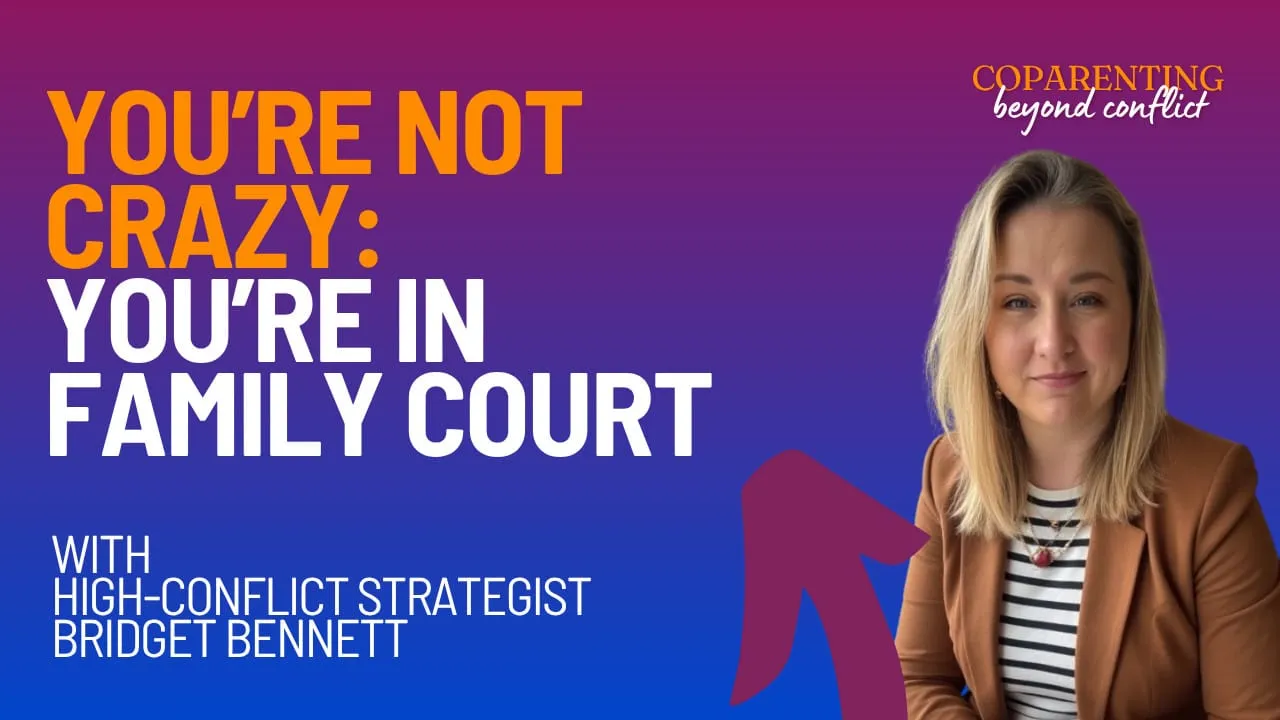
Family court can feel like a war zone — one where you’re expected to show up calm, organized, and child-focused while your ex thrives on chaos.
In this week’s episode of Coparenting Beyond Conflict, I sat down with Bridget Bennett of Breaking Badass Coaching, a Custody Specialist, Legal Strategist, and Certified High-Conflict Communication Coach, to talk about what family court really looks like for co-parents — and how to navigate it without losing your sanity.
Bridget has more than 20 years of experience as a paralegal and now runs Breaking Badass Coaching, where she helps protective parents document effectively, communicate strategically, and advocate fiercely for their children. She’s also a survivor and single mom of four — so everything she teaches comes from both expertise and lived experience.
Listen to the full episode here:
Watch the episode and clips
What Family Court Doesn’t Tell You
One of Bridget’s first lessons: don’t expect justice from the justice system.
She explains that many parents walk into court believing judges or attorneys will automatically see the truth — but the system runs on process, not instinct. Cases move slowly. Attorneys bill in 15-minute increments. And de-escalating conflict isn’t always in anyone else’s financial interest.
That’s why Bridget encourages parents to understand discovery — the written evidence-gathering process that often gets skipped in favor of expensive depositions.
“If your attorney isn’t walking you through discovery, you may be missing the very evidence that could strengthen your case,” she says.
When to Represent Yourself
For parents watching legal bills skyrocket, Bridget says self-representation can be a viable path — but only with preparation and emotional discipline.
She represented herself successfully and now coaches others to do the same.
“Judges don’t know your case as well as you think. Your job is to make their job easier,” she says. “Organize your evidence clearly, show patterns, and stay child-focused.”
That means simplifying your exhibits, removing emotional commentary, and presenting a clear timeline.
Being disorganized — or overly reactive — can instantly undermine your credibility in court.
The Power of Smarter Documentation
If there’s one skill every protective parent must master, it’s documentation. But not all documentation is equal.
Bridget warns against “over-documenting” — flooding your file with irrelevant or emotional exchanges.
Instead, focus on patterns of behavior that directly affect the child.
“Look for what’s happening over six to twelve months,” she says. “It’s not about one bad weekend — it’s about ongoing impact.”
She also recommends keeping all communication in writing — ideally through an app designed to create tamper-proof records.
That’s where tools like BestInterest come in.
BestInterest’s Verified Message Reports turn your conversations into timestamped, court-ready PDFs, while Message Shield® filters out emotionally abusive content so you can respond calmly and professionally.
The BIFF Method: Respond Less, Win More
If you’re dealing with constant accusations, Bridget says resist the urge to reply line-by-line.
Instead, use the BIFF method — Brief, Informative, Friendly, Firm — to keep communication short and neutral.
“The longer your message, the easier it is for your ex to twist your words,” she explains. “Keep it polite, useful, and done.”
Even better? Start and end your messages like a professional email:
“Hi John… Thanks, Bridget.”
This subtle structure often causes high-conflict co-parents to mirror your tone — a clear sign that you’re shifting the dynamic.
Boundaries That Actually Hold
When setting boundaries, Bridget suggests removing emotional fuel.
Her go-to line:
“It is my preference to follow our custody order.”
The word preference diffuses conflict while keeping your stance firm.
And when your co-parent tries to bait you? Respond once — or not at all.
“You’re giving them energy,” Bridget says. “They crave chaos. The moment you stop reacting, you take back your power.”
The Emotional Reset: Rebuilding Self-Confidence
Many survivors of high-conflict relationships walk away doubting themselves as parents. Bridget calls that the conditioning of abuse.
Recovery means reclaiming your sense of worth.
“You don’t have to prove you’re a good parent — you already are,” she reminds. “Use the co-parent’s behavior as a mirror for your own healing.”
That shift — from defense to grounded confidence — is what helps children feel safe.
After each exchange, Bridget says, simply listen to your kids. Offer space, calm, and reassurance:
“I’ll handle the adult problems. You just be a kid.”
Why Coaching (and Calm Tech) Matters
Bridget’s own success came with the help of a co-parenting coach. Now, she’s paying it forward — and even recommends the BestInterest app to her clients.
“I uploaded a parenting plan just to test it,” she laughs. “It coached me on how to respond — I thought, okay, now I like you.”
For her, AI-powered tools and human coaching work hand-in-hand: the app manages day-to-day communication, while coaching helps parents build long-term skills.
If you’re just beginning this process, she recommends starting with a coach before diving into full legal representation. “It’ll save you thousands in unnecessary legal fees,” she says.
Finding Hope in the Hardest Moments
When asked what she’d tell protective parents in their darkest moments, Bridget doesn’t hesitate:
“Don’t give up. You’re doing the right things. Keep going.”
Her wish is simple but profound: that every child can grow up free from abuse, surrounded by compassion and stability.