
Disarming the Narcissist in Your Life: A Conversation with Wendy Behary
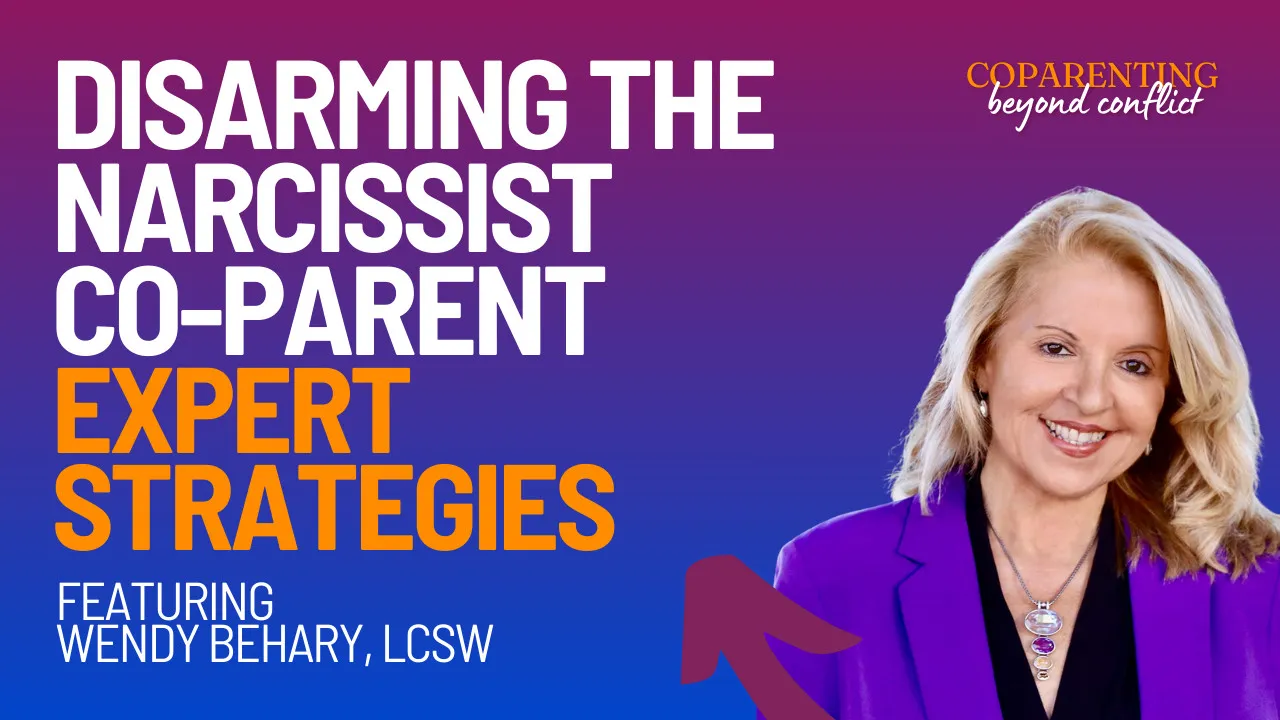
When you’re co-parenting with a narcissist, every interaction can feel like walking a tightrope—especially when the stakes involve your kids’ well-being. On this episode of Co-Parenting Beyond Conflict, I sat down with renowned schema therapist and cognitive therapy expert Wendy Behary to explore what makes narcissists tick, and how those of us co-parenting with them can find peace, power, and healing.
For free coparenting tips and advice from Wendy, listen to our free episode:
Wendy brings over 30 years of experience treating narcissists and those who live with and deal with them—often their partners, children, and co-parents. She’s the founder and director of the Cognitive Therapy Center of New Jersey and Schema Therapy Institutes of NJ-NYC and DC, and a founding fellow of the Academy of Cognitive Therapy. Wendy Behary is also a leading educator with the International Society of Schema Therapy (ISST) and has trained thousands of professionals around the world.
Featuring: Wendy Behary, founder of the Cognitive Therapy Center and Schema Therapy Institutes
Author of Disarming the Narcissist (New Harbinger Publications)
“These are impaired people. Narcissists are wounded. And so are the people around them.” —Wendy Behary
Watch the episode and clips
Understanding Narcissism Through Schema Therapy
“Narcissists aren’t just arrogant or selfish,” Wendy explained. “They are impaired individuals, often shaped by early childhood experiences where they were either excessively praised for achievements or made to feel they were never good enough.”
When I asked Wendy how she got into this line of work, her response made me laugh: “How did I become a masochist who works with narcissistic people?” she joked. But behind the humor was deep insight.
Wendy was drawn to narcissistic clients after realizing that their behaviors triggered something in her—and made her revert to old survival patterns. It was during her work with Jeffrey Young, the founder of schema therapy, that she began modifying techniques to treat narcissists more effectively.
Schema therapy, Wendy explains, goes beyond traditional cognitive therapy. It combines attachment theory, psychodynamic insight, and experiential techniques to address the deeper emotional wounds that narcissists carry.
“We look at different ‘modes’—the inner child, the angry protector, the detached self-soother. Even very young children can understand that we all have different parts.” —Wendy Behary
Many narcissists:
- Fear shame more than anything else and react aggressively when they feel criticized.
- Crave control and dominance to protect their fragile self-esteem.
- Lack true empathy, making them poor co-parents.
- Struggle with emotional regulation, often shifting between charm and explosive anger.
The Roots of Narcissism
So what causes someone to become a narcissist?
According to Wendy, it often begins in childhood. “They come into the world with a certain temperament—and then encounter an environment that doesn’t meet their emotional needs.” These children are often praised for performance, not connection. “They become a surrogate for the parent’s unmet needs,” Wendy explained. “They hear: ‘You’re perfect—but also, not enough.’”
This forms the roots of their shame-based inner critic—a harsh internal voice that they spend their adult lives trying to outrun.
Why This Matters for Co-Parenting
Understanding why a narcissistic co-parent behaves this way helps shift the focus from reacting emotionally to responding strategically. Their behavior is not about you—it’s about their deep-rooted fears and coping mechanisms. Recognizing this allows for emotional detachment, making it easier to set and maintain boundaries.
Can a Narcissist Change?
This is one of the most common questions I get from listeners: is change even possible?
Wendy offered a nuanced answer: “Most won’t go to therapy. And the ones who do are usually forced by consequences—what we call leverage.”
And even then, success is rare. “It requires a sturdy therapist, empathic confrontation, and long-term work. But it is not impossible. The real hope,” she added, “lies in what you can change in yourself.”
“You’re not going to change them—but you can affect meaningful change within yourself.” —Wendy Behary
Empathic Confrontation: The Tool Every Co-Parent Needs
Wendy’s approach to setting boundaries with narcissists is what she calls empathic confrontation—a strategy that blends directness with emotional intelligence. She gave a brilliant example during our conversation:
“You start with: ‘You’re a good guy. I know you care about the kids.’ Even if you don’t feel it. Why? Because narcissists are hypersensitive to criticism and terrified of shame. Then, you follow with your clear, direct message.”
She also offered this practical tip: when a live conversation feels too volatile, record an audio message instead. “It lets you control your tone, revise your message, and remain calm.”
Parenting Under Two Roofs
For many co-parents, the hardest part isn’t just dealing with a narcissistic ex—it’s watching your children navigate that relationship.
“You can’t control everything,” Wendy acknowledged. But what you can do is build your child’s sense of truth and self-worth. “Teach them that people have different parts. Help them name the part of dad that flips pancakes, and the part that gets scary. Help them own their truth.”
“You have the power to break the legacy. Even if your co-parent never changes, you can.” —Wendy Behary
Setting Boundaries With a Narcissistic Co-Parent
Narcissistic co-parents push boundaries relentlessly. They may:
- Ignore custody agreements.
- Show up unannounced to events.
- Insist on doing family activities together despite separation.
- Push back on parenting rules.
- Constantly challenge your boundaries
- Send you hundreds of messages to overwhelm you
How to Hold Your Ground
Wendy teaches empathic confrontation, a communication technique designed to make boundaries clear while minimizing conflict. Instead of arguing, calmly affirm their intelligence and then reinforce the boundary.
Example:
- Instead of: “Stop ignoring our custody schedule! You never follow the rules.”
- Try: “I know you care about stability for the kids, and that’s why we have a schedule in place. I need us to stick to it.”
This method reduces their defensiveness and increases the likelihood of compliance—though, as Wendy pointed out, it won’t work all the time. The BestInterest app can help you be more strategic in your communication.
Additional Boundary Strategies:
- Use the BIFF Method (Brief, Informative, Friendly, Firm).
- Limit direct communication—use documented tools like BestInterest to track agreements.
- Practice the “Narrator Strategy.” Instead of reacting emotionally, state facts as if describing them to an outsider.
- Use voice messages instead of text. This avoids misinterpretation and allows for controlled tone.
Healing the Inner Critic
In our final minutes, I asked Wendy about the role of the inner critic—the self-shaming voice many co-parents struggle with, especially after leaving a toxic dynamic.
She explained how early experiences of discipline and unmet needs form an internal voice that undermines confidence and assertiveness. “But that voice can be retrained. You can learn to disarm it. That’s the work.”
“Be kind to yourself. Parenting is hard. Keep your repair kit handy. You’ll need it—and that’s okay.” —Wendy Behary
How to Quiet the Inner Critic
- Recognize the critic’s voice. Is this an internal belief, or is it something the co-parent (or even childhood influences) instilled?
- Reframe self-doubt. Instead of thinking, “I’ll never handle this,” replace it with, “I am learning how to handle this.”
- Stop seeking their validation. There is no “winning” against a narcissist, and that’s okay. Their approval is unnecessary.
- Stand in your truth. Even when they attempt gaslighting, hold onto your reality. Keep records, rely on outside support, and reinforce what you know to be true.
Helping Children Navigate a Narcissistic Parent
One of the hardest parts of co-parenting with a narcissist is helping children process their parent’s manipulation. Wendy suggests guiding children in recognizing different aspects of their narcissistic parent’s personality without demonizing them.
How to Talk to Kids About Their Narcissistic Parent:
- Explain that people have different “parts.” Example: “Dad is really fun sometimes, but when he’s stressed, he can get impatient. It’s okay to feel both love and frustration.”
- Validate their emotions. Never dismiss their feelings about their other parent, even when difficult to hear.
- Teach self-trust. Help them see they don’t have to agree with everything the other parent says.
- Offer a safe space. Ensure they feel safe expressing themselves freely.
You Have More Power Than You Think
Co-parenting with a narcissist will never be easy, but it is possible to protect your peace by:
- Understanding their tactics.
- Holding firm, well-crafted boundaries.
- Releasing the need for their validation.
- Supporting children emotionally.
As Wendy reminded me: “You don’t have to change the narcissist—you only need to change how you respond.”
For those struggling with a high-conflict co-parent, tools like BestInterest can help by filtering out toxic communication and keeping interactions focused on what truly matters—your children’s well-being.
FAQ: Expert Insights from Wendy Behary
Can a narcissistic co-parent ever change?
According to Wendy Behary, author of Disarming the Narcissist, change is rare and difficult. It usually requires “leverage” (consequences) and a very sturdy therapist. However, Behary emphasizes that while you likely cannot change them, you can change your response to them, which shifts the entire dynamic.
What is ‘Schema Therapy’ for narcissism?
Schema therapy goes beyond standard talk therapy by addressing deep-rooted emotional “modes” formed in childhood. Wendy Behary explains that narcissists often toggle between a “Lonely Child” mode and an “Angry Protector” mode. Understanding these modes helps co-parents stop taking attacks personally and instead see the fragility behind the rage.
How do I use ‘Empathic Confrontation’ with my ex?
Empathic confrontation is a boundary-setting technique where you lower the narcissist’s defenses before delivering your “no.”
- Step 1: Validate a positive trait or their intent (e.g., “I know you want the kids to be happy…”).
- Step 2: State your boundary clearly (e.g., “…but we must stick to the 5:00 PM drop-off time.”). This reduces the “shame trigger” that usually causes them to explode.
How should I talk to my kids about their narcissistic parent?
Wendy advises against labeling the parent as “a narcissist” to the child. Instead, teach them about “parts.” For example: “Dad has a fun part, but he also has a part that gets really angry when he is stressed.” This validates the child’s confusing reality without forcing them to choose sides or carry adult burdens.
More About Wendy Behary
Wendy Behary is the founder and director of the Cognitive Therapy Center and Schema Therapy Institutes of NJ-NYC and DC.
Her private practice is primarily devoted to treating narcissists and the people who live with and deal with them.
She is the author of Disarming the Narcissist (now in its 3rd edition from New Harbinger Publications) and has written several chapters and articles on schema therapy and narcissism.
She lectures nationally and internationally to professional and general audiences and has been featured by Oprah Daily as a leading voice on the subject of narcissism.
You can learn more about her work at disarmingthenarcissist.com.