
Regulate Before You Respond: Somatic Healing for High-Conflict Co-Parenting with Cherie Morris
That ping from your co-parenting app. Your stomach lurches. Your heart starts to beat a little faster, and your palms feel clammy. Before you’ve even read the message, your body is already in fight-or-flight mode, bracing for the criticism, the demand, or the thinly veiled threat you know is coming. If this sounds familiar, you are not alone. This physical, visceral reaction is the reality for millions of parents navigating high-conflict co-parenting dynamics.
You feel attacked, dysregulated, and maybe even addicted to the struggle, constantly checking for the next message, caught in a cycle of reactivity. But what if you could reclaim your power, not by controlling your ex, but by learning to control your own internal response? What if you could find peace, right in the middle of the chaos?
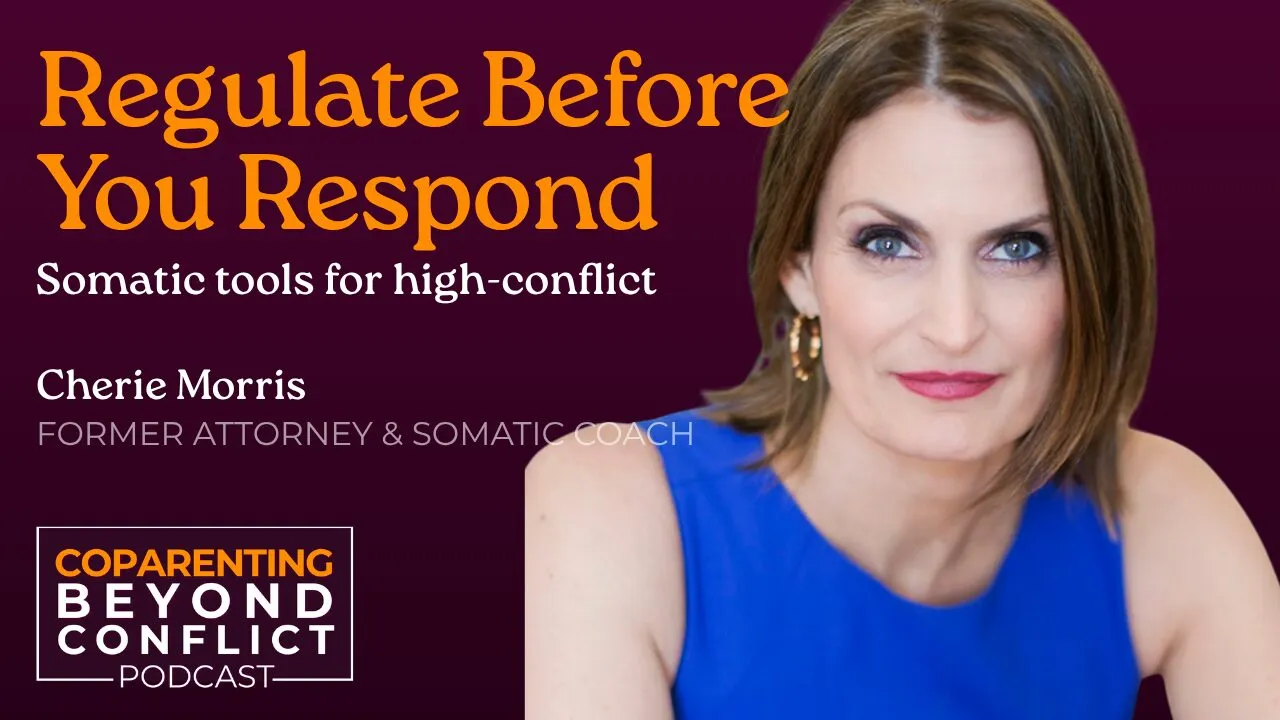
This is exactly what I explored in a recent, powerful episode of the Coparenting Beyond Conflict podcast with my guest, Cherie Morris. A former family law attorney who transitioned into coaching, Cherie brings a unique and profound perspective to de-escalation. She’s an expert in somatic healing—the practice of connecting the mind and body to regulate the nervous system—and she shared tangible strategies to move from a state of constant reaction to one of empowered responsiveness. This conversation was a game-changer, and I want to share the biggest takeaways with you.
Watch the episode
From the Courtroom to the Coaching Room: Why Cherie Morris Prioritizes Peace Over Winning
When I first sat down with Cherie Morris, I was struck by her journey. She spent years as an attorney, often in mediation, trying to help families find cooperative solutions. Yet, she noticed a troubling pattern. “I still found a prevalence of ‘I may even win but I’m still not happy,’” she shared. This gap between a legal “win” and genuine personal peace is what drove her to become a coach.
She realized that the legal system, by its very nature, often fuels conflict. As she put it, the biggest lie high-conflict parents are sold is “that the legal system will solve their problems.” While lawyers are a crucial tool in your toolkit, running to them for every disagreement is not only expensive but often ineffective. A judge doesn’t want to, and often can’t, solve the nuanced, day-to-day friction of co-parenting.
Cherie’s work is now focused on helping people find peace within the conflict. It’s a radical shift in perspective. The goal isn’t to wait for your ex to change—they may never. The goal is to develop the internal tools to remain centered and regulated, no matter what they do. It’s about taking your power back and understanding that, as Cherie says, being right won’t always make you happy.
The Science of the Trigger: Understanding Your Nervous System in Conflict
That immediate, physical reaction you have to your ex’s messages? That’s not a character flaw; it’s your biology at work. Cherie explained it perfectly: “That’s your nervous system artificially engaged in a battle you’ll never win.” Your body perceives a threat—a threat to your relationship with your kids, your financial security, your sense of self—and it floods you with stress hormones. This is a survival instinct.
The problem is, in co-parenting, this instinct often leads to reactivity that makes the situation worse. A quick, defensive reply only fuels the fire and keeps you locked in the power struggle. Cherie’s work focuses on interrupting this cycle.
The key, she says, is to move from being reactive to responsive. Responsiveness isn’t passivity. It’s well-considered action. It’s gathering yourself so that you can make a choice that serves you and your children, rather than one dictated by a dysregulated nervous system.
This is also about the legacy we leave our children. “Kids do what we do, not what we say,” Cherie reminded me. When they see us constantly escalating, they learn that this is how to handle conflict. By modeling self-regulation, we become the cycle breakers we aspire to be, teaching them emotional safety and resilience.
Creating a Buffer for Your Nervous System
One of the most practical ways to begin this journey is to create a buffer between the trigger and your response. This is where technology can actually help. For instance, before you even open a message, especially if it’s been filtered through a feature like the BestInterest Message Shield which removes inflammatory language, you have a crucial moment. That’s your window of opportunity to regulate before you engage. In that moment, instead of diving in, you can practice one of the simple somatic techniques Cherie teaches.
What is Somatic Healing? Simple Mind-Body Tools from Cherie Morris
I asked Cherie to break down “somatic healing” for those of us who, like a former version of myself, lived entirely in our heads. She described it as “the understanding of the integration of mind and body to be the healthiest version of us that we can be.” It’s about paying attention to the signals your body is sending you.
When you feel that tightness in your chest or that racing heartbeat, that’s your body giving you critical data. It’s telling you that you are dysregulated and not in a state to make a clear, rational decision. Somatic practices are simple exercises that help you process that physical stress and bring your nervous system back to a baseline of calm.
For example, Cherie starts her client meetings with grounding exercises. It can be as simple as this:
- Put both feet flat on the floor. Really feel the connection to the ground beneath you.
- Look around the room and silently name three things you see. A lamp. A blue book. A window.
- Acknowledge to yourself: “I am here. I am present.”
This tiny practice, which takes less than 30 seconds, pulls you out of the anxious swirl of future worries or past grievances and anchors you in the present moment. It tells your nervous system that you are safe right now, which allows the logical part of your brain to come back online.
5 Somatic Strategies to De-escalate and Regain Control
During our conversation, Cherie shared several incredibly practical tools that anyone can use. Here are five strategies you can implement today to start regulating your nervous system and responding more effectively in your co-parenting relationship.
-
Focus on Your Breath
It sounds cliché, but it’s the most powerful and accessible tool we have. When you feel escalated, Cherie suggests a simple practice: place one hand over your heart and one on your belly. “This helps our nervous system calm itself,” she explains. Simply focus on your breathing. Notice how jagged it might be. Then, consciously begin to slow it down. Inhale for a count of four, hold for four, and exhale for a count of six. The longer exhale actively signals to your body that it’s time to relax. Do this for just one minute before opening that email or text.
-
Practice Grounding Before You Engage
Make the grounding exercise mentioned above a non-negotiable ritual. Before you open your co-parenting platform—whether you’re using OurFamilyWizard or communicating via BestInterest in Solo Mode—take 30 seconds to ground yourself. Feel your feet on the floor. Name three things you see. This creates a moment of intentional pause, shifting you from a state of anxious anticipation to one of centered presence.
-
Move Your Body to Shift Your Mind
“Moving the body to take care of the mind” was one of Cherie’s most powerful recommendations for someone feeling under attack. When you’re stuck in a cycle of anxious thoughts, the most impactful thing you can do is change your physical state. Go for a walk, preferably outside. “Getting that fresh air in and that body moving changes the trajectory of at least that day and sometimes much more,” she said. It’s not a distraction; it’s a biological reset.
-
Model the Power of the Pause
When interacting with your children, especially during tense transitions, give yourself permission to take a break. Cherie shared how she would tell her own kids, “I’m going to take a minute.” This simple act does two crucial things. First, it prevents you from saying or doing something you’ll regret. Second, it models healthy self-regulation for your kids. It teaches them that it’s okay to feel big emotions and that it’s wise to take a moment before acting on them. This creates deep emotional safety for them.
-
Validate, Don’t Fix (Especially with Your Kids)
When your child comes to you upset about an interaction with their other parent, our instinct is often to fix their pain or, worse, to agree and criticize the co-parent. Cherie advises a different approach: validate the feeling. If your child says, “I’m mad at Dad for talking to you that way,” a responsive answer is, “I hear that you’re mad about that.” You don’t have to fix it or add to it. Simply acknowledging their emotion and being present with them is often all they need. This attunement strengthens your bond without creating loyalty conflicts.
Setting Boundaries That Actually Protect Your Peace
One of the hardest parts of high-conflict co-parenting is setting and maintaining boundaries. Cherie offered a profound reframe: “Boundaries are what we decide we’re going to allow, not what someone else does.”
A boundary isn’t saying, “You can’t text me after 9 PM.” A true boundary is, “I turn my phone off at 9 PM and will not see or respond to non-emergency messages until the morning.” The power is entirely with you. You can’t stop them from sending the text, but you can control whether you engage with it.
This requires breaking what Cherie calls the “addiction to the drama.” Responding instantly with a fiery comeback gives you a shot of adrenaline, a fleeting sense of power. But in the long run, it keeps you chained to the conflict. Choosing not to respond is the ultimate act of taking your power back.
When you receive a provocative message and choose not to engage, you can still keep a record. Instead of replying, open up your Coparenting Journal in the BestInterest app. Document the message, the time it was sent, and your decision not to respond. This creates an objective, time-stamped log that can be compiled into Verified Reports if needed, all without getting pulled into the fight.
Your First Step to a More Peaceful Life
My conversation with Cherie Morris left me feeling incredibly hopeful. The path out of high-conflict co-parenting isn’t about finding the perfect legal argument or waiting for your ex to have a sudden epiphany. The path forward is inward.
It begins with the simple, courageous act of paying attention to your own body. It starts with a single, deep breath. It starts, as Cherie so wisely put it, when we regulate ourselves. You can’t control what they do, but you have absolute power over how you respond. That is where your peace lies.
I highly encourage you to listen to my full conversation with Cherie Morris on the Coparenting Beyond Conflict podcast to hear even more of her wisdom and practical advice.
Resources
- Cherie Morris’s Website: Find articles, resources, and information about her coaching services at DearDivorceCoach.com.
- Psychology Today: An article exploring the basics of Somatic Therapy.
- The Body Keeps the Score by Bessel van der Kolk, M.D.: A foundational book on how trauma and stress live in the body, offering deep insights into the mind-body connection.