
How Dads Can Show Up Better After Divorce with Larry Hagner
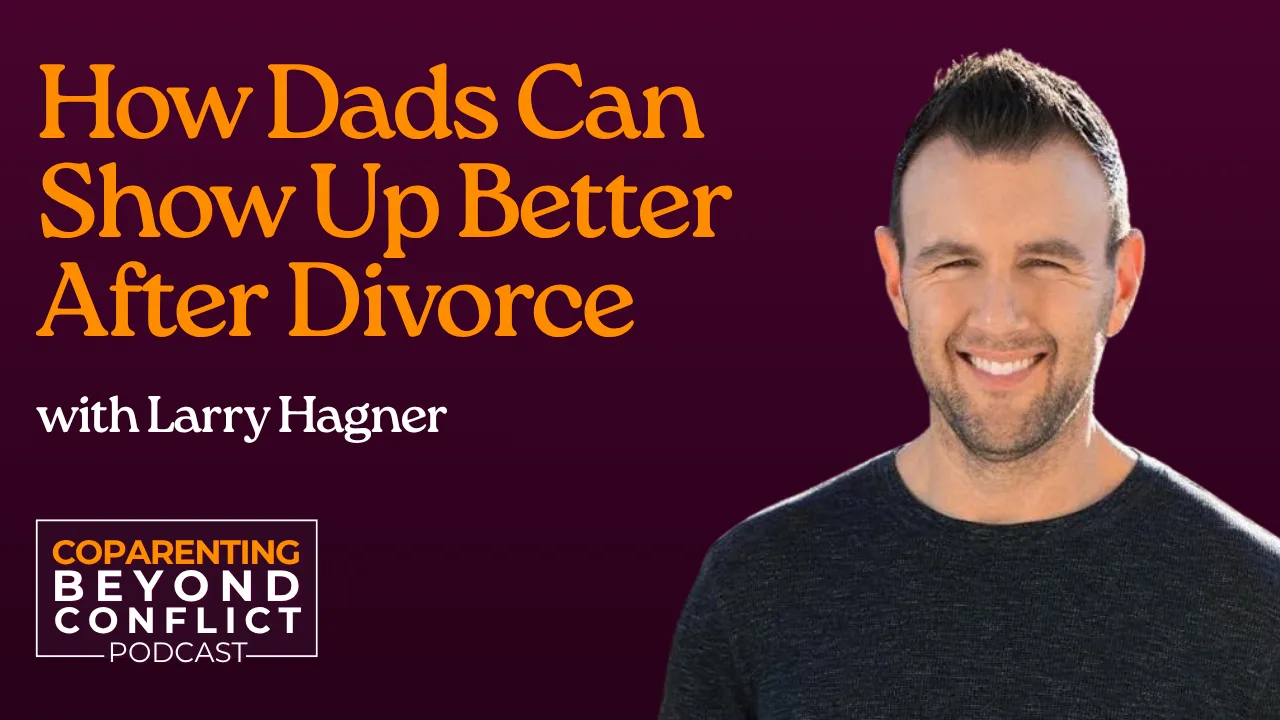
If you are a divorced dad who has ever sat in the parking lot before pickup, dreading the handoff, wondering whether you are doing enough, whether your kids even feel your love through all the chaos — this one is for you. Research consistently shows that involved fathers are one of the single greatest predictors of a child’s emotional security and long-term success. And yet the divorce process has a way of making even the most devoted dad feel like a failure. I felt that tension deeply when I sat down with Larry Hagner, host of the Dad Edge podcast and author of The Pursuit of Legendary Fatherhood, for Episode 14 of Coparenting Beyond Conflict.
Larry has built one of the most trusted communities for fathers in the world — men who want to show up better for their kids, their relationships, and themselves. What struck me immediately about our conversation was his refusal to let guilt win. Larry does not traffic in shame. He trades in skills. And that reframe alone is worth your time.
Watch the episode
What Larry Hagner Means by “Legendary Fatherhood” — and Why It Matters After Divorce
When I asked Larry about his book title, he was quick to validate the absurdity that many divorced dads feel when they hear a word like “legendary.” “We usually always think the opposite,” he told me. “I always think I’m screwing up. I’m not doing this right.”
But here is what his therapist told him that stopped me cold: “Your kids always see you in a better light than what you see you. And they are always rooting for you more than you think.”
That is not a platitude. That is a permission slip. Larry traced this insight back to his own grandfather — a truck driver who was rough around the edges, drank too much on occasion, lost his patience — and yet was the steadiest, most loving male presence in Larry’s life. One morning after a difficult night, his grandfather put his arm around young Larry and said simply, “Grandpa had a little too much to drink last night. That’s not the grandpa I want to be. And I’m really sorry.”
That moment of repair, Larry says, wiped the slate clean immediately. Legendary fatherhood is not about being perfect. It is about making your kids feel seen, heard, and safe — and doing the repair work when you fall short.
Should You Stay Together “For the Kids”? Larry Hagner Has a Nuanced Answer
This is one of the most loaded questions in the divorce space, and Larry did not dodge it. His answer was honest and refreshingly clear: staying in a toxic marriage for the children’s sake is not the selfless act we tell ourselves it is.
“We are a walking, talking, 3-D motion picture at all times of what either good looks like or not good looks like,” he said. “And our kids are taking meticulous notes.”
He shared that when his mother and stepfather finally divorced — he was ten years old — his first emotion was relief. Not devastation. Relief. The tension at the dinner table, the unpredictability, the feeling of emotional unsafety — that was more damaging than the separation itself.
“You can be a great dad and still be a co-parent,” Larry said plainly. That sentence deserves to be printed and stuck to every divorced father’s bathroom mirror. If you are navigating life in two homes right now, I also recommend reading our piece on Parallel Parenting vs. Co-Parenting: Finding the Right Approach for High-Conflict Families to help you decide which model fits your situation.
Fatherhood Is a Skill — Not an Instinct
One of the most practically powerful things Larry said in our conversation is something almost no one talks about: fatherhood is a skill, and skills can be learned. But we do not treat it that way.
“We walk down the aisle, we say ‘I do,’ everyone gives us a hug and says ‘Hey man, best time of your life. You’ll figure it out.’”
He contrasted that with his 90-day intensive training in medical device sales, where even after completing the program, his supervisors told him: “Congratulations. Now you’re really dangerous.” The point? Competence requires structured learning, not just time and good intentions.
Larry referenced John Gottman’s research showing that the one-third of couples who are genuinely happy have a single common denominator: they continue to learn and grow together. They go to counseling, marriage retreats, and coaching. They sharpen the saw. The same principle applies to single and divorced fathers. The dads who show up best are the ones who actively study how to show up better.
5 Strategies Larry Hagner Recommends for Showing Up More Fully as a Dad
- Use the Four Senses to Create Instant Presence. Larry shared a deeply moving story about putting his seven-year-old to bed while his mind was racing with stress. He intentionally closed his eyes and just listened to his son’s voice — then looked at his face, held him close, and noticed the smell of his shampoo. “The brain can only focus on one thing,” he said. All the problems dissolved. Use sight, sound, touch, and smell to anchor yourself into the moment you are actually in.
- Ask Better Questions. Larry gave us one of the most powerful reframes of the episode: shift from “Why can’t I?” to “How might I?” If you just lost your patience with your kid, do not spiral into “Why can’t I be a better father?” Instead ask: “How might I be a more patient father tomorrow?” The quality of your life, he says, depends on the quality of your questions.
- Practice the Experience Cube for Conflict Resolution. This four-step model — Observations, Thoughts, Feelings, and Wants — transforms conflict from a battlefield into a collaboration. Observations are factual, not opinions. Thoughts are owned with phrases like “the story I am telling myself is…” Feelings are one word, not sentences. And Wants go three layers deep: not just what you want, but why you want it and what it would make possible.
- Create Psychological Safety at Home. Larry asks his kids every day: “What did you fail at today? What challenged you?” He wants his children to feel safe enough that at 17, if they have had too much to drink at a party, they will call him for a ride — no questions asked. That trust is built over thousands of small moments, not grand gestures.
- Do the Repair Work. Larry’s grandfather did not pretend nothing happened. He apologized directly and sincerely. Repair is not weakness — it is the foundation of intimacy and trust with your children. If you blew up, went silent, or let your stress leak onto your kids, say so. Kids are extraordinarily forgiving when they feel genuinely seen.
Navigating High-Conflict Co-Parenting: What Larry’s Advice Means for Your Relationship with Your Ex
When I asked Larry about applying the Experience Cube to the most difficult relationship in many of our listeners’ lives — not their partner, but their ex — he was thoughtful. The truth, he acknowledged, is that conflict resolution tools work best when both parties are willing. But even if your co-parent is unwilling, how you communicate still shapes the outcome.
He made a point I found especially powerful: “Do you want to be right or do you want to be effective?” You can be right and still decimate any hope of functional co-parenting. When you shift your internal question from “How do I win this argument?” to “How do I get resolution that protects my kids?” — everything changes.
Larry also spoke about the danger of unstated expectations — the belief that “they should just know by now.” In any relationship, including a co-parenting one, resentment builds around unspoken needs. This is exactly why structured, written communication is so valuable. When you remove the emotional charge from a text exchange, you make space for actual information to travel. That is the premise behind the Tone Guardian feature in the BestInterest app — it reviews your outgoing messages before they are sent, flagging language that might escalate rather than resolve. Think of it as a pause button between your amygdala and your send key. Larry would approve.
For fathers who feel like every co-parenting message becomes a minefield, Solo Mode in BestInterest lets you communicate through a protected, AI-moderated channel — even if your co-parent refuses to use the app. And if you are building a paper trail for court, the Coparenting Journal gives you a private, timestamped record of parenting events, decisions, and concerns — the kind of documentation that speaks louder than emotion in any legal setting. You might also find value in our episode with Derek Salyers on Fighting to Stay a Father in Family Court, which tackles the systemic challenges many dads face head-on.
Larry Hagner on Self-Rejection: The Hidden Reason You Stop Asking for What You Need
One of my favorite moments in our conversation came when I observed that many fathers do not advocate for themselves because they assume rejection is coming — from their ex, from the court, from life.
Larry’s response was immediate: “When you are not speaking up, you are just self-rejecting.”
I want every dad reading this to sit with that for a moment. When you do not ask for more time with your kids, when you do not set a boundary with your co-parent, when you do not reach out for support — you are not protecting yourself from rejection. You are rejecting yourself before anyone else gets the chance.
Larry’s invitation is to build the internal capacity to hold disappointment, and then to ask anyway. That is not recklessness. That is the emotional resilience that legendary fatherhood requires.
The Lightning Round: What Larry Hagner Believes Every Struggling Dad Needs to Hear
I closed our conversation with a lightning round, and Larry’s answers were worth their weight in gold.
- A child’s sense of security comes from… Safety. Psychological safety — the kind where a kid knows they can fail, struggle, and fall apart, and still be loved without condition.
- A father’s most important legacy is… Raising a good, kind human being who can build a fulfilling life without you.
- For the dad who is feeling defeated right now… “It is okay to have a bad day today. But how might I get into a better head space tomorrow?” That question — “How might I?” — is the engine of everything.
Final Thoughts: Larry Hagner and the Permission to Keep Going
What I took away from my time with Larry Hagner is something I want to pass directly to you: the very fact that you are reading this means you are already trying. Your kids see that. They are rooting for you. They are giving you more grace than you are giving yourself.
You do not need to be a perfect father. You need to be a present one — present in the room, present in the conflict, present in the repair. That is legendary. That is enough.
Listen to the full conversation with Larry on Episode 14 of Coparenting Beyond Conflict and share it with any father in your life who needs to hear it. And if you are looking for practical tools to protect your peace and your parenting, explore how the Coparent Coach in the BestInterest app can give you real-time, private guidance through the hardest co-parenting moments — because every dad deserves a sideline coach.
Resources from This Episode with Larry Hagner
- The Dad Edge Podcast: TheDadEdge.com
- The Pursuit of Legendary Fatherhood (Book + Free Courses): TheDadEdge.com/LegendaryBook
- Clear Leadership (Experience Cube): ClearLeadership.com
- Full Presence Training (Free): Available at TheDadEdge.com
- BestInterest App — Tone Guardian: Pause before you send — protect every message
- Derek Salyers: Fighting to Stay a Father in Family Court: Listen on Coparenting Beyond Conflict