
Fighting to Stay a Father in Family Court with Derek Salyers
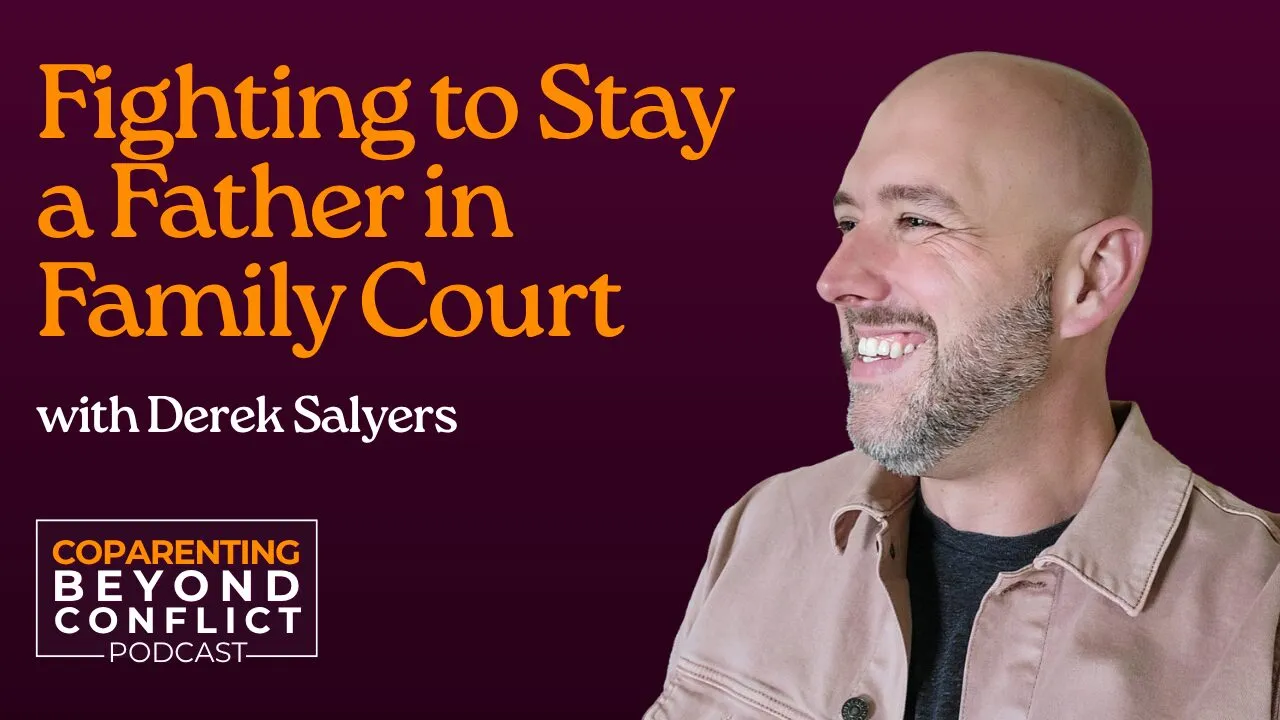
Did you know that studies consistently show children raised without a father figure face significantly higher rates of mental health issues, school dropout, and involvement in the justice system? And yet, every single day, involved, loving fathers are walking into family court and walking out with every-other-weekend visitation — not because they are bad parents, but because the system still carries a deeply embedded bias. When I sat down with Derek Salyers — father, software developer, content creator, and author of The Forgotten Fathers — on a recent episode of Coparenting Beyond Conflict, I knew this was going to be a conversation that would resonate with thousands of parents who feel like the deck was stacked against them before they even stepped inside a courtroom.
Derek’s story is raw, honest, and at times deeply painful. But it is also a story of extraordinary resilience, strategic thinking, and a father’s unbreakable conviction that his son deserved to have him in his life. If you are a parent in the middle of a high-conflict custody battle — especially if you feel like your love for your child is being weaponized against you — this episode and this post are for you.
Please note: this conversation includes discussion of suicidal ideation. Please use your discretion and reach out to the 988 Suicide and Crisis Lifeline if you are struggling.
Watch the episode and clips
Derek Salyers and the Day Everything Changed
One of the most gut-wrenching moments in my conversation with Derek Salyers was when he described the day his wife left. There was no argument. No warning. No conversation. He had gone for a walk around his neighborhood while waiting for his family to come home for their usual evening routine — dinner together, bikes in the driveway, a walk after dark. Instead, he got a voicemail from CPS informing him he was under investigation for abuse and being an unfit parent.
“It blew my mind,” Derek told me. “We never had a conversation. She never mentioned divorce. I had no idea it was coming.”
What followed was three months of zero contact with his son, then supervised visitation for three hours every other Thursday — with his parents required to be present. Derek went from being a daily, hands-on father who documented his family life through a weekly YouTube vlog, to sleeping on the couch of an empty house, staring at the walls. The mental health toll was immense. He openly shared that he got close to the edge during those months. What pulled him back was one thing: his son.
“My son needs me in his life. That’s not an option for me,” he said. “Once I got those dark thoughts out of my head, my focus just went entirely on — I’m going to do whatever I can to win this.”
This kind of experience is far more common than most people realize. The family court system frequently fails trauma survivors, and fathers in particular often enter the system already at a disadvantage. Understanding that dynamic is the first step in fighting back strategically.
How Derek Salyers Used AI to Level the Playing Field in Family Court
Here is where Derek’s story takes a fascinating turn. As a software developer, Derek was uniquely positioned to leverage AI tools in ways that most parents navigating custody battles never think to do. And his use of ChatGPT didn’t just help him understand legal documents — it literally changed the outcome of his case.
His first attorney told him that you cannot submit a shared parenting plan unless both parents agree. That felt like a dead end. But when Derek asked ChatGPT, he discovered that in Ohio, one parent can submit a shared parenting plan independently — and the judge can adopt it. That single piece of information, which his own lawyer got wrong, was the foundation of his entire legal strategy.
Derek also used AI to understand concepts like right of first refusal — a clause that ensures if one parent cannot care for the child during their scheduled time, the other parent gets the first opportunity before a babysitter or daycare is called. That clause alone ended up giving Derek significantly more than 50% of actual parenting time, because he works from home and was available during school pickups and summers.
One thing Derek was equally candid about: AI hallucinates. It makes things up with complete confidence. He described presenting case law to his attorney that ChatGPT had fabricated entirely. “These are not true,” his lawyer told him. The lesson? AI is a powerful starting point, not a finishing line. Always verify independently. If you’re using AI for legal research, treat every output as a hypothesis, not a fact.
For the communication side of co-parenting, tools built specifically for high-conflict situations are even more reliable. BestInterest’s Tone Guardian does automatically what Derek was doing manually with ChatGPT — stripping emotional charge from messages before they go out, so that your texts can never be pulled into court and used against you.
5 Strategies Derek Salyers Recommends for Fathers Fighting for Fair Custody
Throughout our conversation, Derek shared practical, hard-won insights that every parent in a custody battle should hear. Here are five of the most powerful:
- Submit your own shared parenting plan — don’t wait for agreement. Derek’s first lawyer told him this wasn’t possible. It was. In many states, one parent can submit a parenting plan independently, and a judge can adopt it. Know your state’s rules. Use AI as a starting point, then verify with a second attorney. The plan you draft becomes the baseline the court considers, especially if the other parent submits nothing.
- Include a right of first refusal clause. This is one of the most underutilized clauses in parenting plans. It ensures your child spends more time with a parent rather than with a third party whenever a parent’s schedule allows. For Derek, this single clause shifted his actual parenting time to approximately 57% of the year.
- Document everything — starting today. Derek’s years of weekly YouTube vlogs became undeniable evidence of his involvement as a father. Doctor’s appointments, school events, bike rides, Sunday dinners — all on camera, all timestamped. You don’t need a YouTube channel. You need a Coparenting Journal that captures incidents, records tardiness, logs communications, and stores receipts. Derek even started a free tool at CustodyJournal.com for exactly this purpose. At BestInterest, our journal is court-ready and AI-organized, so the most important entries surface when you need them most.
- Use AI to stress-test your own arguments. Derek’s favorite AI prompt: “What might be my blind spots here? What am I not seeing from the other side?” Going into court without understanding the opposing argument is dangerous. AI can play devil’s advocate in a way that prepares you for cross-examination. He also recommends running the same question through both ChatGPT and Gemini simultaneously and comparing their answers.
- Build tiebreakers into your parenting plan. Derek structured his plan so that when both parents disagree on a medical decision, either parent can seek a second opinion — but if disagreement persists, Derek has final say. This prevents every dispute from becoming a return trip to the courtroom. Think like a business drafting a contract: the best parenting plan looks like a business plan.
The Fatherlessness Epidemic Derek Salyers Is Fighting to Reverse
Derek’s individual story is compelling on its own. But what drove him to write The Forgotten Fathers and launch FathersForFairCustody.com was something bigger: the data. As he researched his own case, he kept stumbling into statistics about fatherless homes that he described as nothing short of alarming.
Higher rates of teen pregnancy. Higher rates of substance abuse. Higher rates of school dropout. Higher rates of violent offending and recidivism. Higher rates of mental health struggles. Study after study points in the same direction: children who grow up without a consistent father figure face a measurably harder path.
“I grew up believing 80% of dads who weren’t in their kids’ lives were deadbeats,” Derek told me. “I didn’t know that the system was how the system was.”
His second book, Erased, will tell his personal story more directly — the story of a father who felt systematically removed from his child’s life despite having done nothing wrong. It’s a story that echoes across the community of parents I speak with on this podcast. If you want to understand more about how legal abuse in family court weaponizes the system against protective parents, that article is essential reading.
Derek also makes an important point that I want to amplify: false accusations hurt everyone. They hurt the falsely accused parent. They hurt children who lose access to a loving parent. And they erode credibility for people who are genuinely being abused. Laws are slowly catching up in some states — California is working on legislation that penalizes retaliatory CPS reports — but there is still a long way to go.
Parallel Parenting, Letting Go of Control, and Finding Peace
One of the things I most appreciated about Derek Salyers was his honesty about the emotional and spiritual arc of his journey. Despite winning 50/50 shared parenting after two and a half years and $250,000 in legal fees, he still does not describe his situation as co-parenting in the traditional sense. He calls it parallel parenting — two households, minimal communication, maximum focus on the child.
“It’s very much like, hey, this week is yours. I’ll see you next Sunday when you drop him off,” he said.
For many parents reading this, parallel parenting isn’t a failure. It’s a lifeline. When you are dealing with a high-conflict co-parent, parallel parenting is often the only approach that actually works. It removes the battleground. It protects the children from being caught in the crossfire. And it gives you back your autonomy.
Derek’s approach to controlling communication is one I deeply respect. When his co-parent sends messages telling him how to parent during his time, he simply does not respond — not with agreement, not with pushback. Just silence. It sends a clear message about what he will and will not engage with, without creating evidence of conflict. BestInterest’s Smart Silence feature was built for exactly this kind of boundary — helping you filter what actually needs a response from the noise that is designed to provoke you.
And for the messages that do need to go out, BestInterest’s Message Shield ensures that everything leaving your device has been reviewed for tone, escalation risk, and emotional charge before it reaches your co-parent. If you are in a situation like Derek’s, where every text could theoretically end up in front of a judge, that kind of protection is not optional — it’s essential.
In our lightning round, I asked Derek: “Peace starts when …” His answer: you surrender. Not surrender to defeat — but surrender to the things you cannot control. You cannot control what happens in your co-parent’s house. You cannot control their choices. You cannot control whether the system is fair. What you can control is your response, your documentation, your presence with your child, and your decision each day to keep growing rather than stay stuck.
Connect with Derek Salyers and Take the Next Step
Derek Salyers’ story is one of the most honest and practically useful conversations I have had on Coparenting Beyond Conflict. If you are a father (or any parent) who feels like the system is designed to push you out of your child’s life, I want you to hear this: it is possible to fight back with strategy, not just emotion. It is possible to win. And it is possible to find peace on the other side.
Listen to the full episode with Derek Salyers on Buzzsprout, and explore the resources below. And if you are navigating a high-conflict situation right now and need tools that actually protect you, start with BestInterest. Our Coparent Coach is a free AI-powered guide built specifically for parents in situations like yours — not generic ChatGPT, but a coach that knows the landscape of high-conflict co-parenting and helps you navigate it with clarity.
You do not have to fight this alone. And you do not have to disappear from your child’s life. Keep going.
Resources Mentioned in This Episode
- Listen to the episode: Fighting to Stay a Father in Family Court with Derek Salyers — Coparenting Beyond Conflict, Episode 12
- Derek Salyers’ fathers’ rights website: FathersForFairCustody.com
- Derek’s free custody journal tool: CustodyJournal.com
- Derek’s book: The Forgotten Fathers — available on Amazon
- Related episode: How Dads Can Win in Family Court with Confidence with David Pisarra
- Related reading: Decoding Best Interest Factors: A Plain-English Guide for Your Custody Case
- 988 Suicide and Crisis Lifeline: Call or text 988 (US) if you or someone you know is struggling