
Stop Saying Yes: How Amy Ballantyne Is Helping Co-Parents Break Free from People-Pleasing
If you have ever agreed to a last-minute schedule change you did not want, stayed silent when your co-parent crossed a line, or said yes just to avoid the fight you knew was coming — this episode is for you. Research consistently shows that people who grew up as people-pleasers are statistically more likely to end up in relationships with controlling partners. And when that relationship ends in divorce, the people-pleasing does not magically stop. It just finds a new arena: the co-parenting relationship.
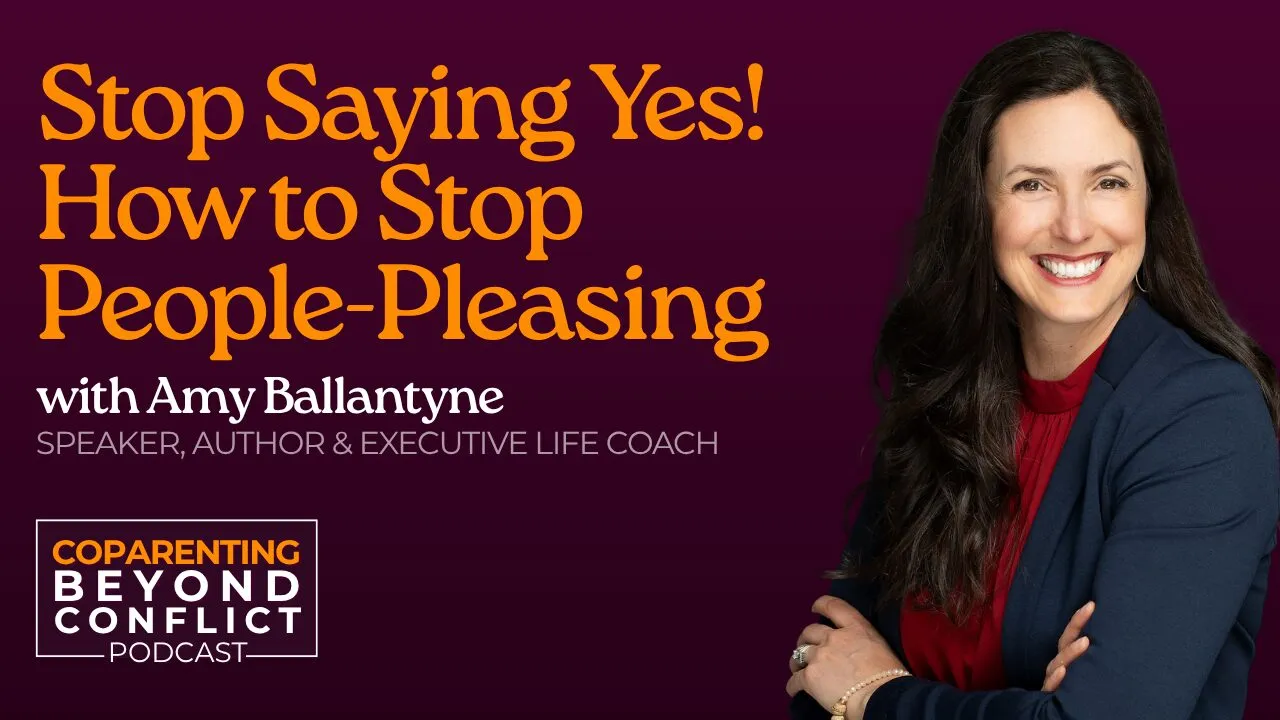
On a recent episode of Coparenting Beyond Conflict, I sat down with Amy Ballantyne — TEDx speaker, executive life coach, and host of the Power to the People Pleasers podcast — for one of the most personally resonant conversations I have had on this show. Amy specializes in helping people break free from that unconscious, conditioned drive to say yes when every cell in their body is screaming no. What she shared has real, practical implications for anyone navigating a high-conflict or parallel parenting situation.
I will be honest: I identify as a people-pleaser in recovery. So this one hit close to home. Let’s get into it.
Watch the episode and clips
Amy Ballantyne on Where People-Pleasing Really Comes From
One of the first things Amy clarified in our conversation is that people-pleasing is not a character flaw — it is a learned survival behavior, usually rooted in early childhood.
“The need to have that approval of your parents, or get that validation that you were doing enough, being enough, or being the good boy growing up — this is a learned behavior that starts very, very young,” Amy told me.
And here is the part that stings a little: unless you actively work to become aware of this pattern and consciously choose different behaviors, you simply continue the cycle. You bring those same approval-seeking lenses to your co-parenting relationship, to your communication, to every negotiation over pickup times and holiday schedules.
Amy also pushed back on the most common misconception about people-pleasers: that they are pushovers with no backbone. “They’re not,” she said firmly. “The story is being told about them, and by them, that they have no needs of their own. That is simply not true.” What is true is that people-pleasers have conditioned the people around them to expect endless compliance — which makes setting a boundary feel not just uncomfortable, but almost dangerous.
This is especially relevant if you are dealing with a co-parent who actively exploits boundary violations. They did not end up in a relationship with a people-pleaser by accident.
The Fine Line Between Healthy Compromise and Self-Abandonment
One of the most nuanced moments in my conversation with Amy Ballantyne was when we tried to draw the line between healthy compromise and full-on self-abandonment. Because not every “yes” is a failure. Sometimes giving in is the right move — especially in co-parenting, where the goal is the well-being of your children.
Amy introduced a concept I found incredibly clarifying: chunking up to the big picture.
“Often where the big challenge and the conflict and the disagreement comes is way down in the details — the nitty gritty of the arguments,” she explained. “If we can move further up into big picture thinking, the details become less important because what’s most important is that higher piece of agreement around the children.”
She gave me this example: two co-parents are fighting about a vacation home, air miles, and whether it’s Saturday or Sunday. But if both of them can zoom out and ask, “What is in the best interest of our child to have the least dysfunction?” — suddenly the argument about Sunday versus Saturday loses its grip.
This is the difference between compromise and self-abandonment. Compromise is when you genuinely align with a decision for a higher reason. Self-abandonment is when you say yes to avoid the discomfort, stuff down your real feelings, and then carry that resentment into the next conversation.
Amy said she actually feels the difference in her body. “I can feel it when I’m aligned with a decision. If there’s incongruence or misalignment, I can feel that too.” That inner knowing is something she encourages her clients to develop — and it is something I personally believe the somatic work so many of our guests have talked about can help you access.
5 Strategies Amy Ballantyne Recommends for Setting Co-Parenting Boundaries
For listeners who are ready to stop defaulting to yes, Amy laid out a clear, actionable path forward. Here is what she recommends:
- Get clear on your non-negotiables before the conversation. Write them down. Know your hierarchy. Which boundary matters most right now? You do not have to tackle everything at once. Start with the one boundary that, if held, would change your experience the most.
- Practice with a trusted friend first. Amy is a strong believer in rehearsing the uncomfortable thing before you are in the room where it counts. Saying “no” out loud, even in a low-stakes environment, helps rewire the conditioned response.
- Use the Agreement Frame when saying no. Amy shared a phrase I love for those last-minute co-parenting ambushes: “I agree this is a challenging situation. I respect that you’re asking for my help. Unfortunately, it’s going to be a no.” This validates the other person without capitulating to them. It de-escalates while holding the line.
- Remember: no is a complete sentence. One of Amy’s most-repeated points in our conversation was this — you do not owe an explanation for your no. The people-pleaser’s instinct is to justify, explain, and apologize. Amy says: resist it. Every reason you give becomes a point to argue against.
- Look for the win-win. Especially when your co-parent is difficult, framing a boundary as a potential benefit for them lowers defensiveness. “If I take the kids for these two hours, would that allow you to have this?” This is not manipulation — it is emotional intelligence in service of a sustainable dynamic.
These strategies are especially powerful when combined with intentional communication tools. If you are finding it hard to respond from a grounded place — especially when a provocative message lands in your inbox — the Tone Guardian in the BestInterest app can help you review your message before you send it, making sure your boundary comes across with calm authority rather than reactivity or over-explanation.
What Your Children Are Learning When You Always Say Yes
This was one of the parts of my conversation with Amy Ballantyne that I did not expect to hit as hard as it did. I asked her: what does a child learn emotionally when they watch their parent constantly giving in to the other?
“They are witnessing a pattern,” Amy said simply. “And it’s likely forming their own.”
She went on to make a point that is both uncomfortable and important: children who always get what they want learn that they always get what they want. And some of those children, as adults, will specifically seek out people-pleasers as partners — because the dynamic is familiar and self-serving. We are not just modeling co-parenting for our kids. We are modeling self-worth.
Amy also offered something that felt like a genuine gift for parents of young children. Before age seven — what she calls the “imprint phase” — children learn primarily through observation, not reasoning. So the most powerful thing you can do is model healthy boundary-setting yourself. Say “no” to things that do not serve you. And when your child says no, receive it with grace. Let them see that their no is respected.
“I told my son, there may be times where you choose to say no to something I’ve asked, and that’s completely okay,” Amy shared. “I am planting those seeds now that it is absolutely acceptable to say no.”
This connects to what I have come to believe deeply: protecting your children’s emotional health is not just about what happens between them and your co-parent. It is about what they see happening inside you.
Amy Ballantyne’s Technique for Staying Centered Under Fire
I asked Amy the question I know so many of our listeners are sitting with: when your co-parent is being disrespectful, dismissive, or just plain cruel — how do you stay centered in your own self-worth?
Her answer surprised me with its gentleness.
“Imagine the younger self of that human,” she said. “Listen through the lens of compassion, so your own response can come from that place.”
She also offered a presupposition she carries into every coaching relationship: people are doing the best they can with the resources they have. That does not mean excusing bad behavior. It means choosing not to be consumed by it. Because the only person you can control is you, and how you show up is your opportunity.
For Amy, self-respect is not something you build by winning arguments or making your co-parent finally see your point of view. It is built by showing yourself kindness over and over again, as she put it in our lightning round. And one of her favorite practical tools for reconnecting with that self-worth? Finding a baby photo of yourself and looking into your own eyes. “I was enough then, and I am enough now.”
If you are in a communication pattern that is eroding that sense of enoughness — if your co-parent’s messages are designed to destabilize you — I want you to know about BestInterest’s Solo Mode, which lets you use the app entirely on your own, with your co-parent communicating through standard SMS. You get the protection and the breathing room without needing your ex to cooperate. Paired with the Coparenting Journal, you can also document what is actually happening — which is a powerful antidote to the self-doubt that people-pleasing and emotional abuse can leave behind.
The Bottom Line: It Is Never Too Late to Say No
One of the most reassuring things Amy Ballantyne said in our entire conversation came right at the end, when I asked her what she would say to someone who feels like it is too late to change the dynamic.
“It is never too late,” she said, without hesitation.
And then she offered a beautifully practical first step: send an olive branch. Not a declaration of war, not a list of grievances — just something kind. A written note, even handwritten if that feels right. Something that says, I noticed you were on time for drop-off. Thank you.
That is where change begins. Not in the courtroom, not in the argument you finally win — but in the moment you decide to show up as the person you actually want to be, regardless of what your co-parent does next.
And if you find it hard to start because you are afraid of how your messages will land — or afraid of the messages you will receive in return — the Coparent Coach inside BestInterest can help you find the words. It is free, it is private, and it meets you exactly where you are.
You can listen to my full conversation with Amy Ballantyne on Episode 8 of Coparenting Beyond Conflict. I promise it is one you will want to come back to.
Resources Mentioned & Recommended
- Amy Ballantyne on LinkedIn: linkedin.com/in/amyballantyne
- Amy Ballantyne on Instagram: @AmyBallantyne
- Amy’s Book: Celebrate Yourself — recommended for anyone working on self-love and stepping out of people-pleasing patterns
- Power to the People Pleasers Podcast: Amy’s own show, featuring expert conversations on approval-seeking, boundaries, and self-worth
- Stop the Chaos: Why Your Ex Loves Co-Parenting Boundary Violations & How to Say No
- Understanding Codependency in Co-Parenting: Signs and Solutions
- Setting Effective Boundaries in Coparenting