
The Umbrella Question: Sam Imperati's Framework for Resolving Co-Parenting Conflict Without a Courtroom
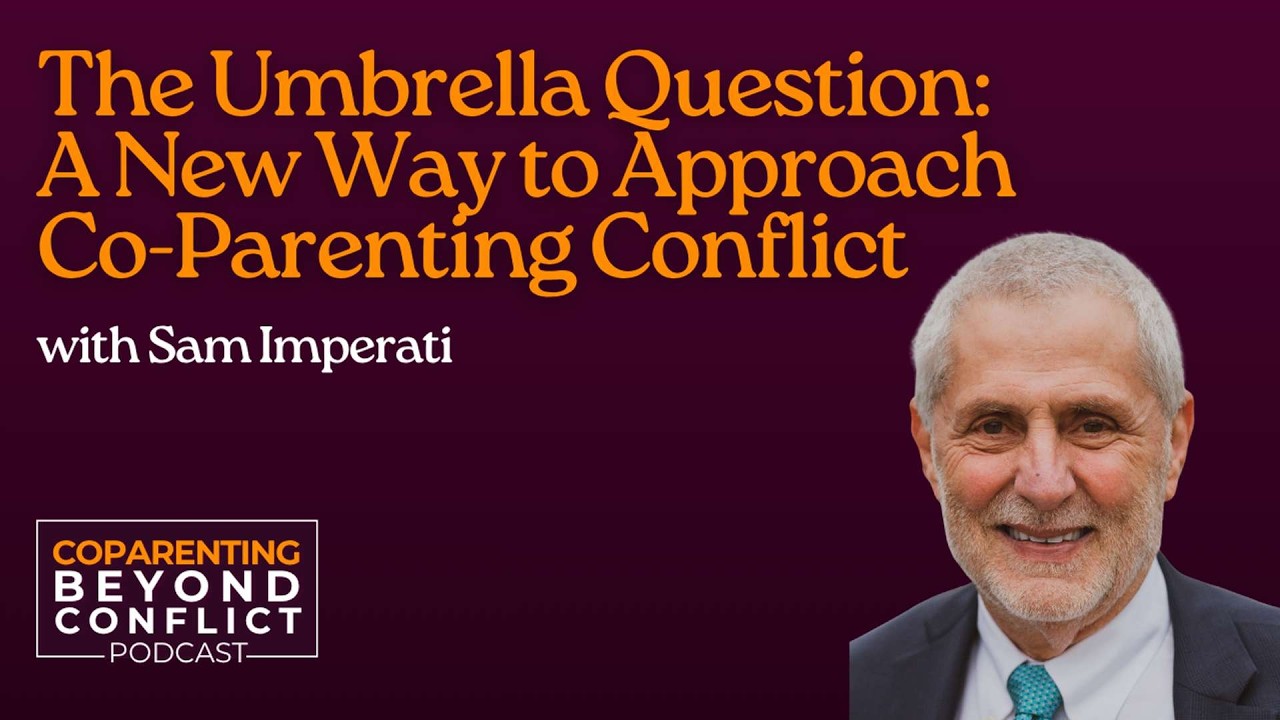
If every conversation with your co-parent feels like a courtroom battle where someone has to win and someone has to lose, you are not alone. So many parents I speak with are exhausted — not just from the conflict itself, but from the endless cycle of positioning, arguing, and documenting that never seems to actually move anything forward. That is exactly why I was so grateful to sit down with Sam Imperati on Episode 21 of the Coparenting Beyond Conflict podcast.
Sam is an attorney, former judge, and now a full-time mediator with decades of experience helping people navigate the messy intersection of logic and emotion. He has seen the litigation system from every angle — as a pit-bull trial lawyer, as the person in the black robe, and as someone who went through his own divorce with five lawyers in the room. What he learned from all of it is that there is almost always a better way. And in this episode, he shared a practical framework called the Umbrella Question that I think every co-parent needs to hear.
Why “Winning” in Court Leaves Everyone Feeling Empty
One of the first things Sam Imperati said that really stopped me in my tracks was his description of what happens to the so-called winners after a trial:
“They walked away with a putative victory that wasn’t very fulfilling in the long run. The process just left them empty, as though the wind had been sucked out of them.”
So many co-parents I work with enter divorce proceedings imagining a dramatic moment — the truth prevails, the judge rules in their favor, and justice is served. Sam watched this play out hundreds of times from the bench, and the reality almost never matched the expectation. It is time-consuming, expensive, emotionally draining, and the outcome is never guaranteed.
Worse, when both sides feel victimized by the process, they carry that resentment into every future interaction. Sam described it as a self-perpetuating negative loop — each parent constantly looking for the next opportunity to be revalidated, to balance the scales of fairness. And the people who suffer most? The kids.
“Everything gets documented, everything is looked at through the lenses of suspicion, everything is logged for a future battle. There is not an exploration of what is in the best interest of the kids — it is a process of documentation to have ammunition for what everyone perceives to be the next battle.”
If you recognize yourself in that description, I want you to know: it makes complete sense that you got there. The system almost pushes you toward it. But there is a way out.
Setting Your True North: The Best Interests of Your Children
Before Sam even introduced the Umbrella Question, he offered something simpler and equally powerful — the idea of establishing a true north that guides every co-parenting decision.
His mantra, both professionally and personally, became: What is in the best interest of the children?
He acknowledged that feelings of being wronged, manipulated, or aggrieved are real. But he challenged us to ask one question before acting on those feelings: How will indulging this impact the kids?
This reframe does not erase your pain. It gives your pain a purpose — because instead of asking “how do I win?” you start asking “what actually helps my child thrive?”
Sam also made a point that I think about a lot as a co-parent myself. When we model vengefulness, resentment, and zero-sum thinking, we are teaching our children that those are the tools you use when life gets hard. When we model reasonableness, empathy, and resolution — even imperfectly — we are giving them something they will carry for the rest of their lives.
What Is the Umbrella Question (and How Does It Work)?
This is the centerpiece of my conversation with Sam Imperati, and it is genuinely one of the most practical conflict frameworks I have encountered in all my years working with co-parents.
Sam explained that most arguments get stuck at the level of positions — what each person says they want. We exchange positions, we support them with arguments, and we escalate until someone runs out of steam. He described a pattern he noticed on the bench:
“People in conflict present their arguments in increasing order of absurdity.”
Because we can never let the other person have the last argument. So we keep going, even as the arguments get weaker.
The Umbrella Question cuts through that by going beneath positions to interests — the underlying needs, values, and motivations driving each person’s stance. Here is the fill-in-the-blank structure Sam shared:
“How can we address [your needs] while at the same time [my needs], thereby accomplishing [what we have in common]?”
In a co-parenting context, that shared common ground is almost always some version of: our children living their best, most productive lives.
Here is a real example from our conversation. Instead of debating whose schedule takes priority, you might ask:
“How can we accommodate your need for a predictable routine while also allowing for my occasional evening work commitments, thereby creating a stable and flexible environment where our kids can thrive?”
Notice what just happened. The conversation shifted from a debate — where one person wins and one loses — into an exploration, where both people are sitting on the same side of the table, looking at the same problem together.
5 Ways Sam Imperati Suggests Using the Umbrella Question in Real Co-Parenting Life
-
Lead with it, don’t wait for conflict to escalate. Sam pointed out that if you know your co-parent’s patterns well enough (and most of us do), you can actually write their portion of the umbrella question before the conversation begins. Walking in prepared with a balanced framing takes the wind out of an adversarial approach before it starts.
-
Use it as a credibility builder, not a concession. Worried about appearing weak? Sam made a compelling counter-argument: a reasonable, balanced position is harder to attack. If your co-parent accuses you of being self-interested, you can calmly point to the fact that your framing explicitly included their needs.
-
Bring in a neutral third party when needed. Sam was clear that the Umbrella Question does not work in every situation, especially when a co-parent is truly not operating in the child’s best interest. In those cases, a skilled mediator can hold the space — because, as Sam noted, people tend to moderate their behavior in front of a neutral third party.
-
Use the co-parent echo to your advantage. If you find yourself constantly hearing your co-parent’s voice in your head, anticipating their objections and reactions — Sam reframed that as a superpower. That internal echo gives you the data you need to pre-build their side of the umbrella question with empathy and accuracy.
-
Remember that reasonableness is visible — and judges notice it. Sam confirmed something I have long believed: a co-parent who presents as reasonable in a courtroom signals to the judge how they likely behave outside of it. Being measured and balanced is not just the right thing to do — it is strategically smart.
High-Conflict Co-Parenting and the Limits of Any Framework
I want to be honest with you, because Sam Imperati was honest with me. The Umbrella Question is a powerful tool, but it is not a magic wand. Sam acknowledged plainly that there are co-parenting situations where one parent is truly not focused on the child’s wellbeing, and that some cases genuinely do need to be adjudicated.
If you are dealing with a high-conflict or potentially personality-disordered co-parent, one of the most protective things you can do is manage your communication carefully. I created the BestInterest co-parenting app specifically for situations like this — where you need to stay child-focused and boundaried even when the other parent is not.
The app’s Tone Guardian reviews your outgoing messages before you send them, helping you strip out anything that could escalate tension or be used against you later. And if incoming messages from your co-parent are hostile or triggering, the Message Shield filters that hostility so you can read the factual content without absorbing the emotional charge. Both tools are practical extensions of exactly what Sam was describing — keeping your communication reasonable, child-focused, and documented.
And speaking of documentation: Sam’s observation that high-conflict co-parents often document everything as ammunition is real. The co-parenting journal inside BestInterest is designed to help you document things differently — not as ammunition, but as a clear, timestamped record that reflects your consistent, child-focused approach.
The Surprising Role of Humor in Conflict
One of my favorite moments in this episode was when Sam talked about using humor as a tension diffuser — including a story from the bench where he literally left his seat and leaned against the wall to wait out two lawyers who kept arguing over each other.
“I think it’s harder to be a jerk when you’re smiling and the mood is lighter.”
Now, Sam was clear that humor is a tool he can use more freely as a neutral mediator than a party can use in their own conflict. But he offered one accessible entry point for the rest of us: self-deprecating humor. Acknowledging when your own tone slipped, or when you made an “assholian move” (his words, not mine — though I love them), can be disarming in the best possible way. It signals humanity. It creates a reset. It opens the door back to exploration.
A Final Word from Sam Imperati
At the end of our conversation, I asked Sam to complete a few lightning-round prompts. The one that has stayed with me most:
The moment a co-parenting dispute is actually resolvable is when… “both parties suspend disbelief and commit to exploring versus debating.”
That is it. That is the whole shift in one sentence. From debate to exploration. From positions to interests. From winning to what actually helps our kids.
If you are in the middle of a co-parenting conflict right now, I want you to try something small before your next difficult conversation. Write down the umbrella question. Fill in your co-parent’s needs as honestly as you can. Fill in your own. And find the shared outcome at the end — the one that is really always about your children.
You do not have to have a mediator in the room to start thinking like one.
Listen to the full conversation with Sam Imperati on Episode 21 of Coparenting Beyond Conflict, available now on Buzzsprout. If this episode resonated with you, please subscribe and leave a rating — it helps more co-parents find the support they need.
Resources
- Sam Imperati’s mediation practice: www.ICMresolutions.com
- Coparenting Beyond Conflict Podcast: bestinterest.app/coparenting-podcast
- BestInterest Co-Parenting App: bestinterest.app/app
- Co-Parenting Plan Guide: bestinterest.app/co-parenting-plan-guide
- Psychology Today – Finding a Mediator: psychologytoday.com