
Why Adult Children Cut Off Their Parents (And How to Prevent It) with Catherine Hickem
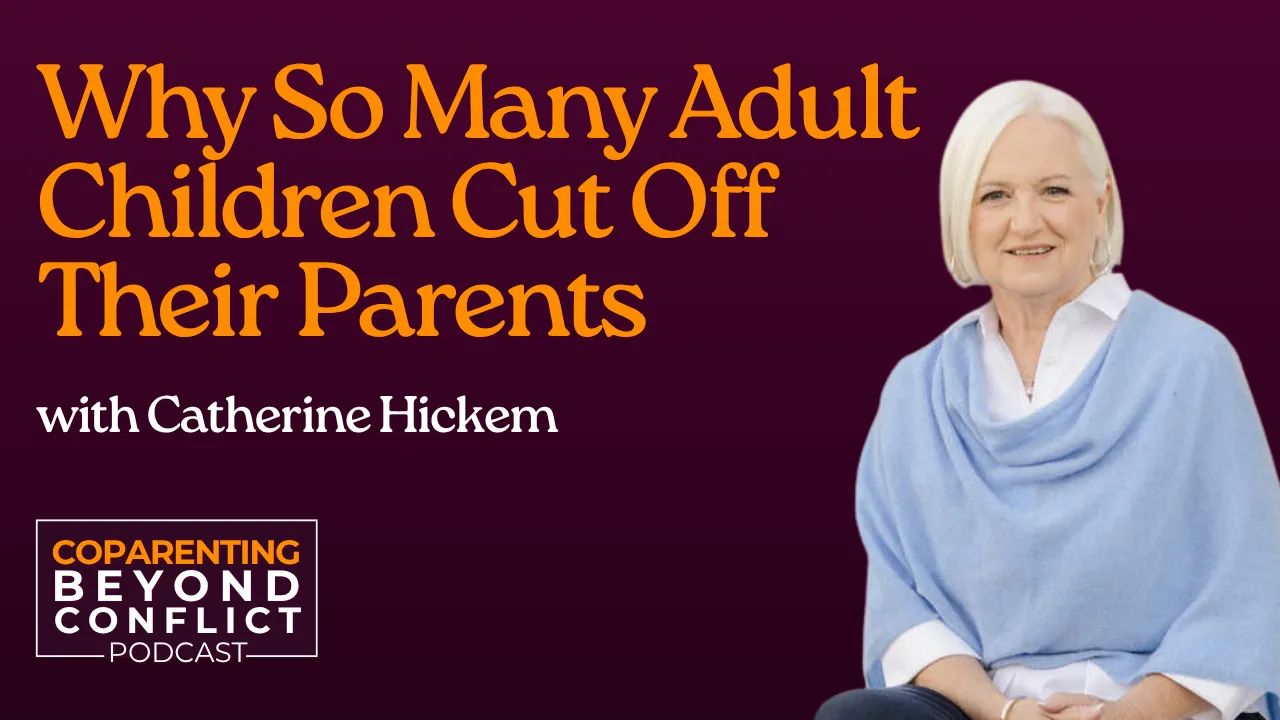
One in four adult children in the United States is not speaking to at least one parent right now. Let that sink in. That’s 27 million people—27 million families fractured by silence, estrangement, and unresolved pain. When I sat down with Catherine Hickem, founder of Parenting Adult Children Today and author of It’s Never Too Late to Be a Great Parent, on a recent episode of Coparenting Beyond Conflict, she called this exactly what it is: a cultural crisis. And for those of us navigating divorce, it’s a crisis that hits especially close to home.
Whether your children are still young, or you’re an adult child yourself trying to figure out how your own parents fit into the wreckage of your divorce, this conversation was one of the most eye-opening I’ve had on this podcast. Catherine brings both clinical insight and deeply personal experience—including her own divorce after 35 years of marriage—to a topic that rarely gets discussed in the co-parenting space: what happens to family bonds across generations when a marriage falls apart.
Watch the episode
Catherine Hickem on the Estrangement Epidemic: Why It’s Happening
The numbers alone should stop us in our tracks. Catherine shared that 27% of adult children between 18 and 45 have cut off at least one parent—and in roughly 80% of cases, it’s the adult child making that choice. This isn’t a fringe issue. It’s a generational wave, and divorce is one of the most powerful catalysts for it.
But here’s what Catherine wants parents to understand: most of these estrangements don’t happen because of abuse. They happen because of something far more insidious—the slow accumulation of unmet needs, ignored boundaries, and silent disappointments.
“Parents don’t know that they don’t know,” Catherine told me. “And that’s why I’m doing what I’m doing.”
She pointed to two primary drivers of estrangement that she sees again and again in her work:
- Boundary violations — particularly when parents ignore or minimize the limits their adult children set, especially around grandchildren.
- Unspoken expectations — the weight of what parents hoped their children would become, transmitted through criticism, judgment, and preaching.
One story Catherine shared really struck me. A well-known public figure had been sharing stories about her adult children on stage—after her children had explicitly asked her to stop. She ignored it. They cut her off. Not just from themselves, but from their children too. A simple boundary, repeatedly dismissed, became the end of a relationship.
This pattern plays out in quieter ways in co-parenting families all the time. If you’re going through a high-conflict divorce, you may already be watching your own parents—or your ex’s parents—take sides, overstep, or disappear. Catherine’s framework helps make sense of why, and more importantly, what to do about it.
What Catherine Hickem Says Adult Children Actually Need During Divorce
If you’re a parent going through divorce and your children are adults, the instinct is often to lean on them—to vent, to process, to seek validation. Catherine was clear: that’s a mistake.
“It’s not our children’s job to be a comforter to us in the circumstances,” she said. “They’re the kids and our job is to be supportive of the impact this is going to have on them.”
Even when your children are 25 or 30, divorce is a grief event for them. The family structure they knew—holidays, traditions, the rhythm of how things worked—is gone. Catherine reminded me that grief shows up differently in different people. It might look like anger. It might look like withdrawal. It might look like your adult child suddenly not returning your calls for six months.
“Give your children enough time to figure out the truth,” she said. “They’ll figure it out. In most cases, they’ll figure it out.”
Her own daughter needed six months before she came back and said, “I totally understand. How can I support you?” Catherine could rest easy because she had never spoken ill of her ex-husband during that waiting period—not once.
This mirrors what we talk about constantly in the co-parenting space. Whether your children are 5 or 35, keeping them out of the middle is non-negotiable. If you’re struggling with how to communicate without pulling your kids into adult conflict, the Coparent Coach in the BestInterest app can help you think through how to frame difficult conversations—without burdening your children with details they should never have to carry.
The 4 Pillars of Healthy Parent–Adult Child Relationships
One of the most practical frameworks Catherine Hickem shared on the episode was what she calls the four pillars of a healthy relationship with an adult child. If you’re in the thick of divorce right now and thinking about the long game—about the relationship you want to have with your kids when they’re grown—this is the roadmap.
- Respect. Treat your adult children as adults. Stop making decisions for them. Stop assuming you know what they need. Ask. Include them. Honor their “no.” As Catherine put it, “If you respect them when they’re younger, they’ll respect you when they’re older.”
- Getting to know who they actually are. Not who you hoped they’d become—who they actually are. Their values, their interests, their perspective on the world. Catherine told me about a moment when her daughter’s friend Jason said that Tiffany was the only friend he had who was the same person in front of her parents as behind their backs. He wasn’t. He’d learned to perform a version of himself that kept his parents from crying or getting angry. That’s what unmet expectations do to a family.
- Acceptance. You don’t have to understand every choice your child makes. You don’t have to agree. But acceptance means your relationship isn’t contingent on them meeting your expectations. “My understanding isn’t paramount to my loving you,” is how Catherine put it.
- Unconditional love—communicated clearly. Here’s the statistic that stopped me cold: more than 50% of adult children do not believe they are unconditionally loved by their parents. Parents think they’ve said it. But when judgment, criticism, and favoritism fill the space, the words don’t land. Catherine also cited that 53% of adult children with a mental health problem do not go to their parents for help. That’s not a statistic—that’s a warning.
Navigating Grandparent Loyalty During High-Conflict Divorce
This is where the conversation got really rich for our audience. What happens when your adult child—the one going through a brutal, high-conflict divorce—asks you to cut off your relationship with their ex? What happens when you’re the grandparent trying to stay connected to grandchildren while both parents are at war?
Catherine’s advice: get curious before you get defensive.
“What’s your biggest fear of us having a relationship with them?” she suggested asking. “I want to understand what the fear is.”
Fear of disloyalty, fear of being left out of the grandchildren’s lives, fear that you’ll share things you shouldn’t—these are all real and valid. Once you understand the fear, you can negotiate boundaries together instead of burning bridges.
Catherine also shared something deeply personal: she discovered that her own mother had been secretly maintaining a relationship with her ex during the divorce—sending birthday gifts, staying in contact—without telling Catherine. “The hurtful part was she didn’t tell me,” she said. “To me, it was a question of respect.”
Transparency and honesty, even when it’s uncomfortable, protect the relationship. Secrecy, even when well-intentioned, destroys trust at the worst possible time.
If you’re in the middle of a high-conflict situation where loyalty tests are flying everywhere, you might also want to read about how children get pulled into messaging roles in divorce—because the same dynamic plays out with grandparents and extended family, not just with kids.
5 Things Catherine Hickem Wants Every Divorcing Parent to Remember
- Your divorce is happening to your children—not just to you. Even adult children grieve the loss of their family structure. Make space for that grief without making them carry yours.
- Don’t share intimate details of the marriage. “It’s none of their business, first of all,” Catherine said. High level is enough. They’ve had a front-row seat. They already know more than you think.
- Ask, don’t assume. What kind of support do they want? What boundaries do they have around your relationship with their ex? Ask first. Always.
- You can only control yourself. “I can only control me. I can’t control anyone else,” Catherine reminded us. “It actually gives me relief.” Channel your energy into showing up with integrity, not into managing everyone else’s reactions.
- Never stop being the safe harbor. Catherine’s most powerful image from our conversation was this: be the harbor your child can dock in when the storms come. Not a harbor that turns them away if they arrive battered or broken. A place they know is always safe.
How to Protect Your Parenting Integrity During Divorce
Whether you’re the parent going through the divorce or the grandparent watching from the sidelines, Catherine Hickem makes one thing unmistakably clear: you will never regret doing the right thing.
“You’ll never regret being respectful. You’ll never regret having integrity. And you’ll never regret being the right person doing the right thing.”
One of the hardest parts of high-conflict divorce is staying grounded when everything around you is chaos. If you’re struggling to keep your communications with your co-parent clean and child-focused, tools like BestInterest’s Tone Guardian can help you pause before you send something you’ll regret—especially in those moments when your feelings are loudest and your judgment is clouded. And if you need a private space to process everything that’s happening without burdening your kids or your parents, the Coparenting Journal gives you a confidential, date-stamped record of your own experience—just for you.
The insight Catherine shared about legacy also hit home: “When you die, what do you want them to say about you?” That’s the question. Not whether you were right about their career choice. Not whether they followed your religion. Whether they knew, beyond any doubt, that you loved them.
That’s the work. And it starts now, no matter where your family is in this process.
Listen to the Full Episode with Catherine Hickem
This conversation with Catherine Hickem is one I keep coming back to. The 27% estrangement statistic alone should be a wake-up call for every parent—but it’s Catherine’s warmth, honesty, and practical roadmap that makes this episode truly transformative. Whether you’re in the thick of divorce, rebuilding after it, or trying to figure out how to show up as a grandparent in your adult child’s fractured family, this one is for you.
Listen to Episode 15 of Coparenting Beyond Conflict with Catherine Hickem here.
And if you haven’t already, explore how BestInterest’s Solo Mode can help you communicate with your co-parent more clearly and calmly—protecting your integrity and your peace in every message you send.
Resources Mentioned
- Catherine Hickem’s Organization: Parenting Adult Children Today
- Catherine’s Book: It’s Never Too Late to Be a Great Parent by Catherine Hickem
- Podcast Episode: Episode 15 – Coparenting Beyond Conflict with Catherine Hickem
- Related Reading: Understanding Your Child’s Experience of Divorce – Christina McGhee
- Related Reading: Raising Emotionally Secure Kids After Divorce – Dr. Karalynn Royster
- Related Reading: Tell Your Mother…: How to Protect Your Child from Being a Messenger in Divorce